
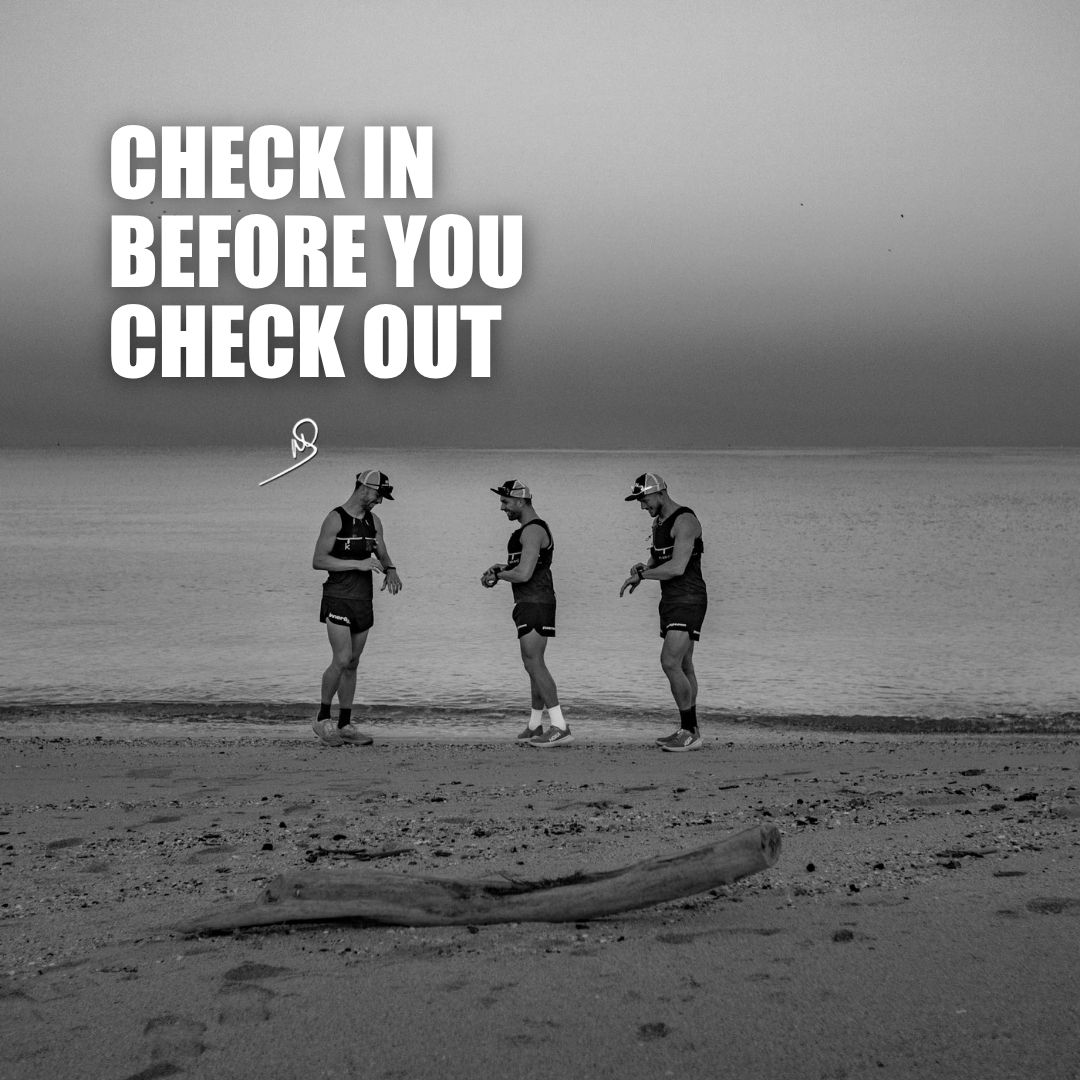


Check In Before You Check Out
Most people are drawn to outcomes because outcomes appear decisive. They create the illusion of movement, resolution, and progress without requiring prolonged attention to the conditions that produce them. Presence, by contrast, is slower, less visible, and far harder to outsource, which is why it is so often bypassed.
“Checking in” is a term used frequently. It means different things to different people that’s for sure. At its core it is deliberate observation of how we operate over time in terms of things like effort, avoidance, reaction and recovery. The secret part of checking in is the ability to refrain from immediately attempting to justify or correct what is seen. This requires restraint. It requires tolerating ambiguity long enough for clarity to emerge rather than be manufactured. There is a big difference.
Humans looking to unlock the best version of themselves are rarely lacking in drive. We know this. The evidence is overwhelming. What they often lack is friction. Speed has served them well. Decisiveness has been rewarded. Constant forward motion has become both habit and identity. Over time, this can produce results while quietly eroding coherence.
Checking in is the necessary interrupter of this cycle. It forces the slow down. It invites friction in. A friction that we need. It begins with questions that are not designed to confirm competence or preserve momentum, but to expose misalignment. Questions that cannot be answered quickly, and therefore demand patience, attention, and a willingness to remain with discomfort rather than escape into action.
One of the huge results that emerges is the commitment that follows this process, it is different. It is not fuelled by emotion or urgency, but by accuracy. When behaviour aligns with stated values, effort becomes quieter and more consistent. Less energy is spent managing perception, and more is available for execution. Reallocation of energy moves the needle.
Enjoyment emerges here, though it is rarely recognised as such. Not pleasure, but engagement. The capacity to remain present with repetition, constraint, and gradual progress without needing novelty or external validation. Those who develop this capacity endure. Those who do not eventually search for exits. The divide is very clear and as we continue to operate in the ever “busy” world it grows.
There is a key requirement however, by the name of openness. A requirement, not a preference. There is a big difference. To be open is to allow examination without defence. To be vulnerable is simply to remove distortion. At this level, honesty is not expressive, it is functional. Without it, feedback cannot exist, and without feedback, adaptation stalls.
I ponder it often. How to live in this space, how to coach in this space. The living is my ongoing desire and daily work which I strive to be better at day after day. The coaching is fascinating. It does not rely on instruction or motivation. As I said earlier this audience are supercharged. It operates through observation, questioning, and the consistent application of standards. The individual remains responsible. Always.
Giving people a chance begins with listening long enough to understand their context before attempting to improve it. I have had the honour of sitting with people for hours across multiple sessions and believe me or not saying very little. Most failures in performance are not due to lack of capability, but to unexamined assumptions carried forward at speed. The speed often supported by simply a cheerleader who has not listened nor offered the right questions to slow things down. The key is the speed, slower not faster. There is enough fast.
Speed and friction are the tools, listening and questions are the vehicle they travel in. Checking in is slow, answers take time, sometimes a long time. Uncertainty exists and interactions are rare. It may feel hard, at times unnecessarily slow but ultimately it will deliver far more than we could ever ask for.
No Weakness.
Marcus
Comments