
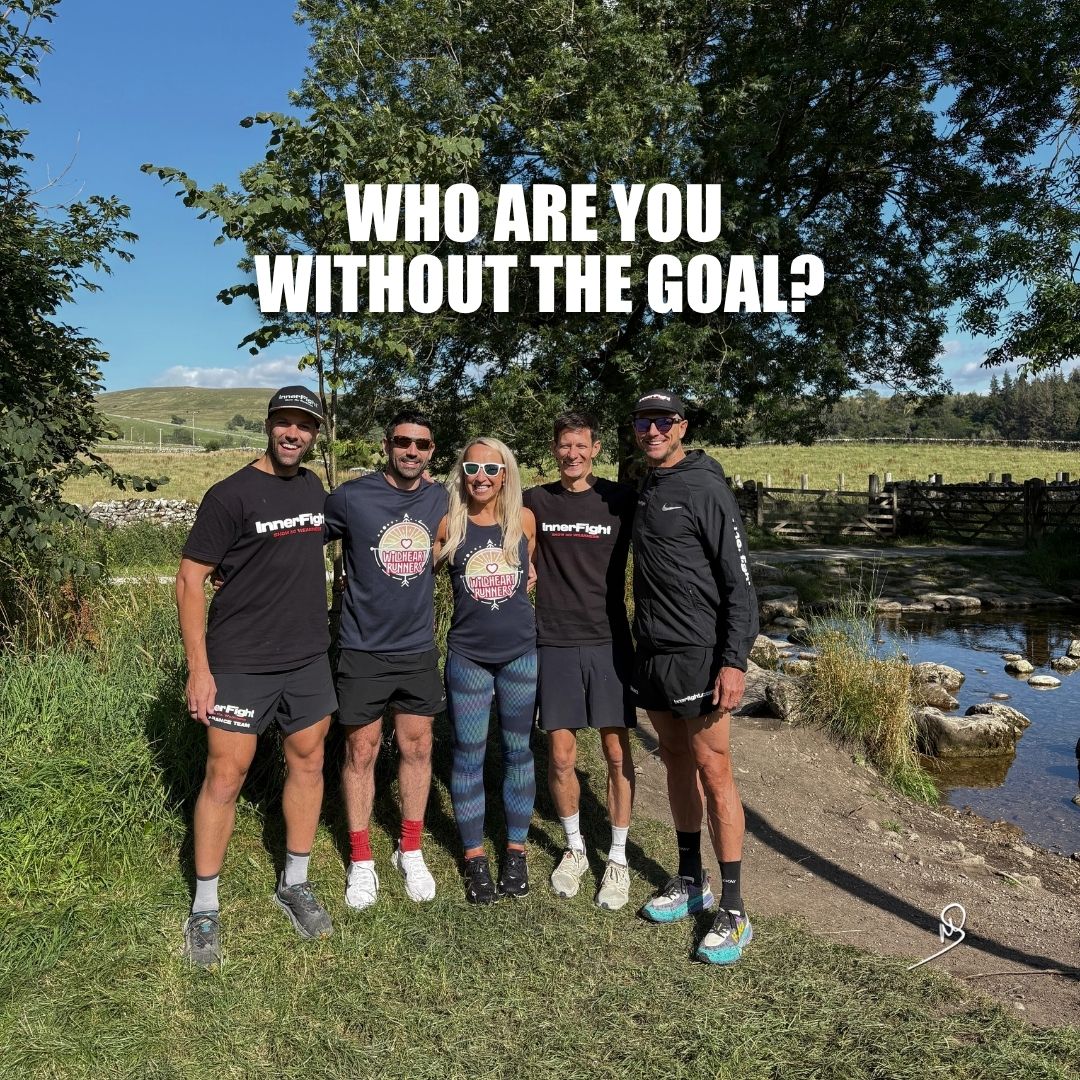


Who Are You Without the Goal?
Take away the race and most people stop. Not because they lack discipline, but because they lose direction. The goal was never just something to achieve. It gave structure to effort, meaning to discomfort, and a reason to keep showing up.
When that disappears, something more confronting is revealed. Without something to chase, who are you actually being?
In 2018, a messaged dropped into my Instagram asking for coaching help. Instagram used to be good like that. As is our process we sent the potential client a few questions. A whole load of questions to be honest so we can really understand the human. From there we hop on a call. Probably Skype back then, seems like a lifetime ago.
The Irish voice of Keith Russell 5,000 miles away filled my ears. My attention immediately had to increase just to translate what he was saying. At times I genuinely thought he was flipping into Gaelic. He started to explain to me his clear objective at the time: to run the Marathon des Sables. He was fired up, that I could tell from his voice. It was a goal that demanded enough to shape his decisions and justify the work required. Like many endurance goals, it created clarity. He also had a very deep drive behind it.
Then the goal disappeared.
COVID arrived and the race was gone. No timeline, no event, no external anchor. For many people, that is where things fade. The absence of a goal removes urgency, and without urgency, consistency often disappears with it. It is quite a wicked circle that I have seen play out many times during my coaching career.
This was different though, Keith was different. We kept going, but the nature of the work changed. Without the race, there was no longer an external outcome driving the process. What remained was the process itself, and more importantly, the person inside it.
For all of the clichés that came out of Covid not many of them resonated with me. Pivot perhaps the least of the lot. But of course if you detach feelings from something and take it as it is then it makes sense. It was not the words fault that everyone was using it. It made total sense. So that’s what we did.
Keith shifted toward backyard ultras. On paper, it is a simple format: run one loop (6.7km) every hour until you can no longer continue. In reality, it exposes something deeper. There is no finish line pulling you forward, no variation to distract you, no moment of relief waiting ahead. You return to the same place, again and again, until you can’t.
Over time, for some people a very short period. The event stops being physical. It becomes psychological. It becomes a test of how long you can remain steady in your own mind without needing escape.
In 2023, Keith ran 89 loops, yes that’s 89 hours, 3 days 17 hours. At the time it was a British and Irish record. But records don’t explain much. They are outcomes, not causes. They show you what happened, but not what made it possible. What made it possible was not a single block of training or a perfectly executed race. It was the decision to stay with the work long after the original goal had disappeared. Years of showing up without needing a clear finish line. 5 years after our first chat. Long service awards for both of us! It was an honour to be in Germany that day for those 89 hours with Keith.
During that race another message dropped into my Instagram from a lady called Karen Nicol. She had been intrigued by Keiths success. Already experienced in ultra running Karen didn’t need direction in the traditional sense. What she needed was perspective. ‘What are you talking about Marcus?’ Bear with me, there is a difference. Direction tells you what to do. Perspective changes how you understand what you are doing. It is the understanding that brings the longevity in most cases.
We chatted, about back yards, about life, probably way more about life. Life is what makes life happen right? Many months later we started working together and are now 175 weeks into our partnership! During that time, Karen has also achieved significant performances in backyard ultras, at one point holding the British and Irish record. But like Kieths and pretty much all records, it was temporary.
What lasted for Karen was something else. Her focus expanded beyond her own performance. She built Wild Heart Runners, a coaching community designed to help women across the UK experience running in a way that felt safe, supported, and sustainable. It wasn’t built around pressure or comparison, but around enjoyment and confidence. Very different to the motivations we see behind many things.
As the world moves in it’s own weird ways, Keith later became part of that same coaching environment, and in December 2025, they took a group of women to run the Malaga Marathon together. That moment carries more weight than any individual result. Not because of the race itself, but because of what it represents. Something that moved beyond personal achievement into shared experience.
Over the last 8 years of my coaching Keith and Karen, yes we worked on training and implemented training plans to get them these amazing results. But a large amount of our work was and continues to be way beyond that. Training plans are rarely the limiting factor, I often say the training is the easy bit. What really limits people is internal friction. Doubt that appears when things become difficult. Pressure that builds when expectations rise. The quiet belief that you are close to your limit, even when you are not. These are the things that shape performance long before any session begins.
That is where many of our conversations go. Often not in a structured or predictable way, but in a way that allowed those things to be seen clearly. Over time, that clarity reduces noise. And when the noise reduces, performance becomes more stable.
In the ultra and endurance communities and perhaps in life as a whole, there is a common belief that progress comes from doing more. More volume, more intensity, more effort. But often progress comes from removing what interferes. From understanding where resistance is coming from instead of trying to overpower it. This kind of work is slower, and because of that, most people avoid it. It doesn’t provide immediate feedback. It doesn’t create dramatic shifts in short periods of time. It requires time, and time is something people struggle to trust.
Time removes urgency. Without urgency, there is no immediate sense of progress. Just repetition, exposure, and small adjustments that don’t seem significant in isolation. But over time, those small shifts accumulate into something far more stable.
Records will always fall. Someone will always go further, last longer, or perform better. That is the nature of sport. But what doesn’t fall away as easily is composure. The ability to stay steady when things become uncertain. To make decisions without panic. To continue without needing constant reassurance. That ability is not built in competition. It is built in the quieter moments between efforts, where there is no external validation.
Over time, coaching becomes less about instruction and more about creating space. A space where people can think clearly, step back from reaction, and see what is actually happening rather than what feels urgent. Not every conversation leads to an answer. Some simply remove noise. And when the noise is gone, people tend to move forward in a way that is more aligned and more sustainable.
There is a pattern in all of this. Not in the outcomes, but in the approach. A willingness to stay. To stay when the goal disappears. To stay when progress slows. To stay when there is nothing immediate to show for the effort. Most people leave too early. They change direction before they understand where they are. They look for something new before they have fully experienced what they are already in. But depth does not come from constant change. It comes from staying long enough for something to reveal itself.
What Keith and Karen built were not just records or results. Those were just visible moments. What they built underneath is harder to define, but far more difficult to take away. And it only came from one thing.
They stayed the course.
Have a think. Do you stay the course when the goal is gone? Who are you without the goal?
No Weakness
Marcus
Comments